We operate a multi-token economy designed to support decentralized communication and
reward our node operators. Here’s a quick breakdown of how each token works:
$DGRAM
Primary token for payments, rewards, and governance. Earned by running nodes, used to buy services,
and exchanged on open markets.
$DATA
Stable utility token pegged to the USD. Created when $DGRAM is burned — used to purchase services and
protect users from price volatility.
Reward Points
Earned based on node resource contributions. Automatically settled into $DGRAM daily.
$UDP Points
Earned by nodes processing UDP-based traffic,ideal for real-time data transmission (e.g., audio
and video calls, gaming).
$TCP Points
Earned by nodes handling TCP-based traffic, requiring high reliability and accuracy (e.g.
streaming, messaging, storage).
$AI Points
Earned by nodes processing AI-related traffic, combining compute and low-latency data for real-time
inference (e.g., model training, synchronization).
The core of Datagram’s ecosystem
Tokens overview
Each token plays a distinct role in powering Datagram’s decentralized economy — from
rewards and payments to governance and growth.
$DGRAM
The ecosystem's primary token used for payments, rewards, and governance. Node operators earn
$DGRAM based on their contribution to the network. It can be exchanged, reinvested, or utilized within
the Datagram ecosystem.
$DATA
A stable, non-transferable token pegged to USD, specifically for service payments within Datagram. It
provides predictable pricing by converting $DGRAM to $DATA based on a 3-day moving average, limiting
market volatility.
Reward Points
Non-transferable tracking points that record node contributions and convert to $DGRAM daily,
providing a transparent rewards model based on network support.
$UDP Points
Earned by nodes processing UDP-based traffic, ideal for real-time data transmission (e.g., audio
and video calls, gaming).
$TCP Points
Earned by nodes handling TCP-based traffic, requiring high reliability and accuracy (e.g.
streaming, messaging, storage).
Token utility
How Datagram tokens power our ecosystem
Incentives and rewards
Tokens motivate participation and contribution across the network.
Burn-and-Mint equilibrium
Balances emissions and usage to ensure long-term sustainability.
Governance participation
$DGRAM holders help shape the future of the network through voting.
Circular value flow
Used for rewards, licensing, and internal economy with real utility.
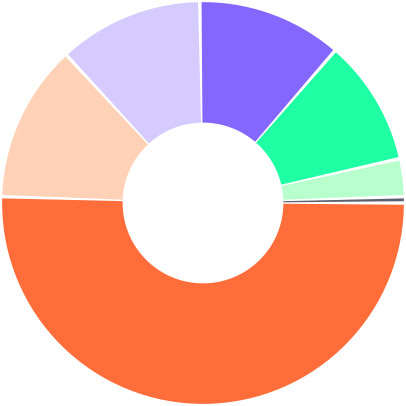
Datagram token distribution model
Token distribution
Capped at 10 billion, $DGRAM tokens are distributed strategically to fuel long-term
ecosystem growth and provide sustainable incentives for node operators - all within a deflationary model.
50%
Node operators rewards
Reserved to reward our node operators.
13.5%
Ecosystem development
Dedicated to expanding and sustaining our ecosystem.
10%
Investors
With a 36-month vesting schedule to support network stability and confidence.
12%
Team
With a vesting schedule, ensuring team commitment to Datagram’s growth.
10%
Market makers and exchanges
Allocated to ensure liquidity and accessibility on exchanges.
3%
Advisors
Attracts industry expertise and guidance for long-term success.
1.5%
Key opinion leaders (KOLs)
Used to drive awareness and inspire more users.
Your rewards as a node operator
REWARDS potential
Our model gives you consistent rewards based on your contribution to the network. We
emit 0.125% of the latent supply daily to reward node operators for uptime and resource contribution ensuring
fair returns.
Operate a node
Share your bandwidth and compute — no deep tech needed.
Conversion of reward points
Receive reward based on uptime and performance.
Participate in the network
Earn $DGRAM by joining initiatives and supporting network growth.
Exchange purchase
$DGRAM is tradable on multiple exchanges for buying or reinvesting.
Shape Datagram’s future through $DGRAM
governance
Governance and voting
Token holders propose and vote on upgrades, reward changes, and ecosystem growth
— securing decentralized decision-making.
faq
Node sale
How is Datagram so cost-efficient?
Datagram leverages a decentralized infrastructure that eliminates the need for
costly centralized data centers. By utilizing a distributed network of nodes, bandwidth and computing
resources are optimized, significantly reducing operational expenses. The economic model also benefits
from blockchain-based incentives that encourage efficiency and participation.
What is DePIN?
DePIN (Decentralized Physical Infrastructure Network) is a blockchain-driven
network that provides real-world infrastructure services in a decentralized manner. It ensures greater
security, transparency, and efficiency by removing intermediaries and enabling direct peer-to-peer
interactions. It is also more resilient and resistant to crashes than centralized infrastructure.
What is Real-Time Communication (RTC)?
Real-Time Communication (RTC) is the transmission of data with minimal delay,
allowing for seamless interactions in voice, video, messaging, and other applications. RTC is crucial
for applications requiring instant communication, such as video calls, gaming, and financial
transactions.
What makes Datagram interactions so seamless, secure, and scalable?
Datagram employs an advanced decentralized networking protocol that optimizes
data routing, reducing latency and enhancing reliability. Its blockchain-based architecture ensures
aligned incentives between users, node operators, and token holders. The robust protocol allows for
end-to-end encryption, securing user data from unauthorized access. Additionally, its modular and
scalable infrastructure allows it to handle massive traffic without congestion or performance
degradation.
What is latency?
Latency refers to the time delay between sending and receiving data. It is a
critical factor in communication networks, particularly in applications requiring real-time responses,
such as gaming, video conferencing, and financial transactions. Lower latency improves user experience
and system efficiency.
What makes Datagram decentralized?
Datagram operates on a decentralized network of nodes rather than relying on a
single central authority. This ensures enhanced security, resistance to censorship, and increased
reliability. The distributed nature of the network prevents single points of failure and improves
performance through localized data processing.
What are the patents that Datagram holds?
Datagram holds patents related to its decentralized networking protocol,
real-time data transmission, and blockchain-based infrastructure solutions. These patents provide a
competitive edge by securing unique innovations in the field of DePIN and RTC.
What is web 2.5?
Web 2.5 is an intermediary phase between Web2 (centralized internet) and Web3
(fully decentralized internet). It incorporates blockchain and decentralization while maintaining
user-friendly interfaces and experiences akin to traditional Web2 applications, easing adoption for
mainstream users.
How does Datagram stand out in comparison to its competitors?
Datagram differentiates itself through its decentralized, low-latency, and
high-security architecture. Unlike traditional centralized networks, Datagram offers cost-efficient
scalability and data integrity while ensuring seamless RTC experiences. Its unique blockchain
integration enhances trust and efficiency.
What are nodes?
Nodes, called "Cores" within the Datagram ecosystem, are decentralized
computing units that process, store, and transmit data within the Datagram network. They play a
crucial role in maintaining network integrity, ensuring data security, and optimizing communication
efficiency.
Is Datagram B2B, B2C, or B2B2C?
Datagram operates under a B2B2C model, providing infrastructure solutions for
businesses that ultimately serve end consumers. This approach enables enterprises to integrate
decentralized RTC technology while maintaining seamless user experiences. While it will always be
possible for power users to connect and use the Datagram ecosystem as web3 users, the majority of
users will always be web2 and contribute to the token economy without an awareness that they are using
decentralized architecture.
Who are the lead investors?
The lead investors include strategic venture capital firms specializing in
blockchain, DePin, and decentralized networking technology. Their investments support the growth and
expansion of Datagram's ecosystem.
What is Datagram aiming to solve?
Datagram seeks to address inefficiencies in real-time communication, high
infrastructure costs, security vulnerabilities, and latency issues in centralized networks. By
leveraging decentralization, it provides a more scalable, cost-effective, and secure alternative.
Why is the vesting so long?
The extended vesting schedule ensures long-term commitment from investors, team
members, and node operators. It prevents rapid token dumping, stabilizes the ecosystem, and aligns
incentives for sustained growth.
What purpose does the token serve in the ecosystem?
The Datagram token ($DGRAM) facilitates network transactions, incentivizes node
operators, and enables governance participation. It also powers premium services, ensuring seamless
and secure interactions within the ecosystem.
What purpose do the nodes serve?
Nodes provide decentralized infrastructure for Datagram, processing and
transmitting data while maintaining network security and reliability. They enable real-time,
low-latency interactions across various applications.
Are node operators compensated?
Yes, node operators are rewarded with $DGRAM tokens for contributing
computational resources, bandwidth, and storage to the network. Compensation is based on participation
and performance metrics. At launch, 80% of the rewards will come from uptime, but as time goes on this
will transition to usage based on network statistics and stability.
How many users can the platform handle?
Datagram's decentralized architecture is highly scalable, allowing it to
support millions of users simultaneously. The network dynamically adjusts to demand, ensuring
uninterrupted service even during peak usage.
How does Datagram apply to a customer's everyday experience?
Customers benefit from low-latency, secure, and cost-efficient communication
services, whether through voice, video, or messaging applications. Datagram enhances digital
experiences across social interactions, gaming, and financial transactions.
How does Datagram apply to a business's everyday experience?
Businesses leverage Datagram for secure and scalable RTC solutions, reducing
infrastructure costs and enhancing customer interactions. Its decentralized network supports various
applications, including customer support, collaboration tools, and live-streaming services.
Are businesses and customers aware that they are using blockchain technology when interacting with
Datagram technology?
Not necessarily. Datagram abstracts the complexities of blockchain technology,
providing a seamless user experience similar to traditional Web2 applications. Users benefit from
enhanced security and efficiency without requiring blockchain expertise.
Why is blockchain used in Datagram technology?
Blockchain ensures data integrity, security, and transparency within the
Datagram ecosystem. It eliminates intermediaries, reduces operational costs, and enhances network
resilience, making it an ideal solution for decentralized real-time communication.